


I typically share to critique, but in this case, I’m sharing to praise. A Burned Haystack community member shared this screenshot from her son’s employee handbook. Please take a look, and then let’s talk about what it does well.
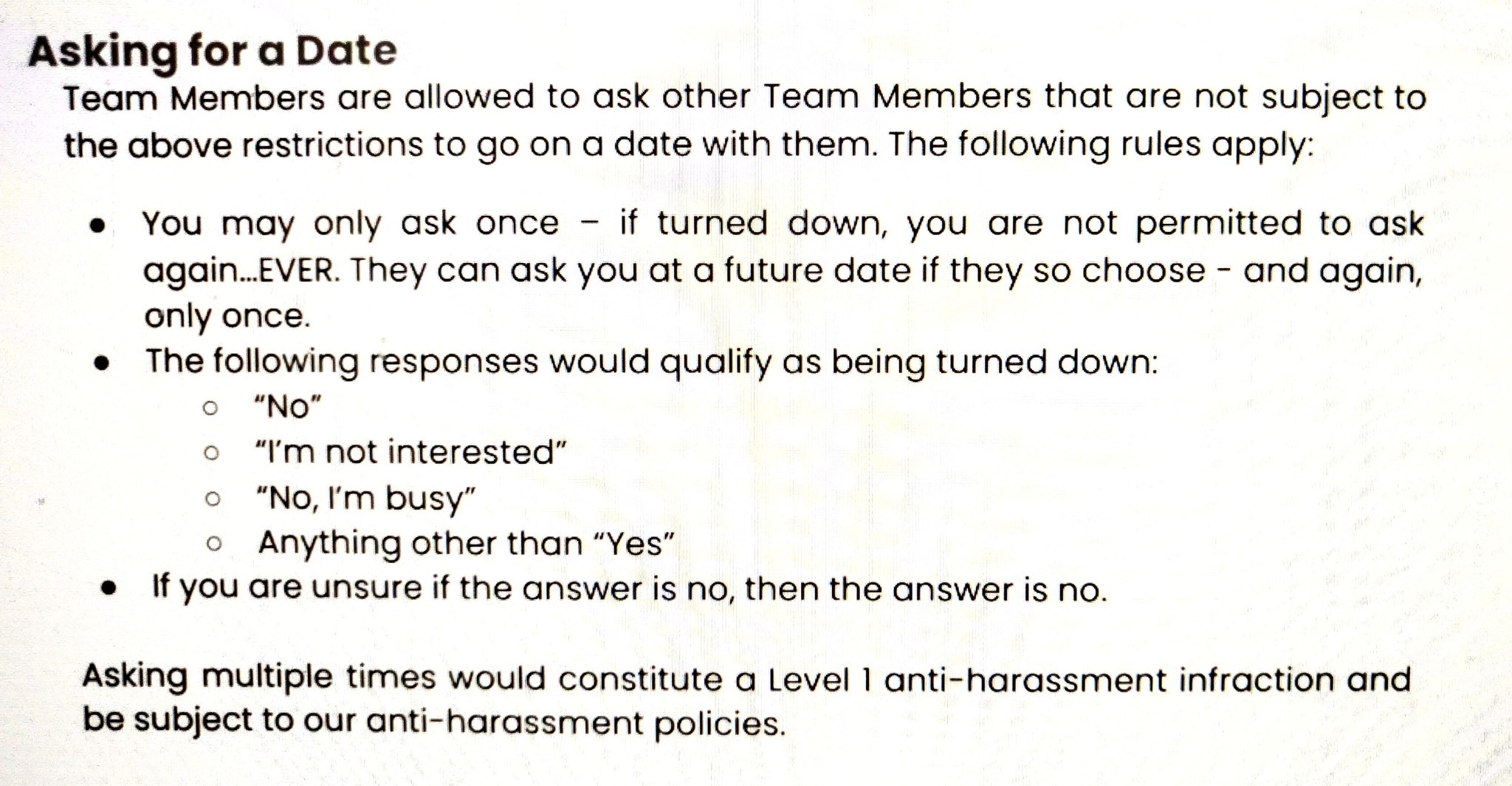
Here’s what’s working:
It doesn’t default to an unrealistic-and-therefore-certain-to-be-violated “zero tolerance” policy that forbids workplace romances. Such policies are unreasonable and limiting; many happy and healthy couples met at work [note: it does include the phrase “not subject to the above restrictions,” which may refer to the fact that supervisors can’t ask subordinates out (makes sense; complicated power dynamics and the potential for exploitation/retaliation there)].
It’s written in PLAIN language rather than legalese.
It gives concrete examples rather than vague directives.
It’s *crystal clear* about what constitutes a “no,” AND it articulates that the no stands FOREVER, regardless of what form the “no” takes.
It smartly utilizes graphic/mechanical strategies to enhance clarity: bulleting, white space, punctuation, capitalization, quoting. It’s easy to gloss over such features of writing, but professional writers know *exactly* how crucial these things are to comprehension. This snippet does an excellent job.
The rhetorical clarity here reminds me of this viral video that likens tea-drinking to sexual consent. If you haven’t seen it, it’s worth your time:
You know where I saw this EXACT LANGUAGE long before this? Rules for a kink event. The kink community has had consent policies in place like this for a long time. If it's not an ENTHUSIASTIC YES, it's a "no"!
It works in absolutely every situation I can think of too.
Simplicity is so good for so many reasons. My 12yo recently cited the tea video in angsty dinner table talk about navigating a socially awkward situation. I can’t tell you what joy it brought this single mama. “But mum, remember that video, you know that one - if you don’t want tea, you don’t have to drink the tea.”