
Minimalism: A Love Story

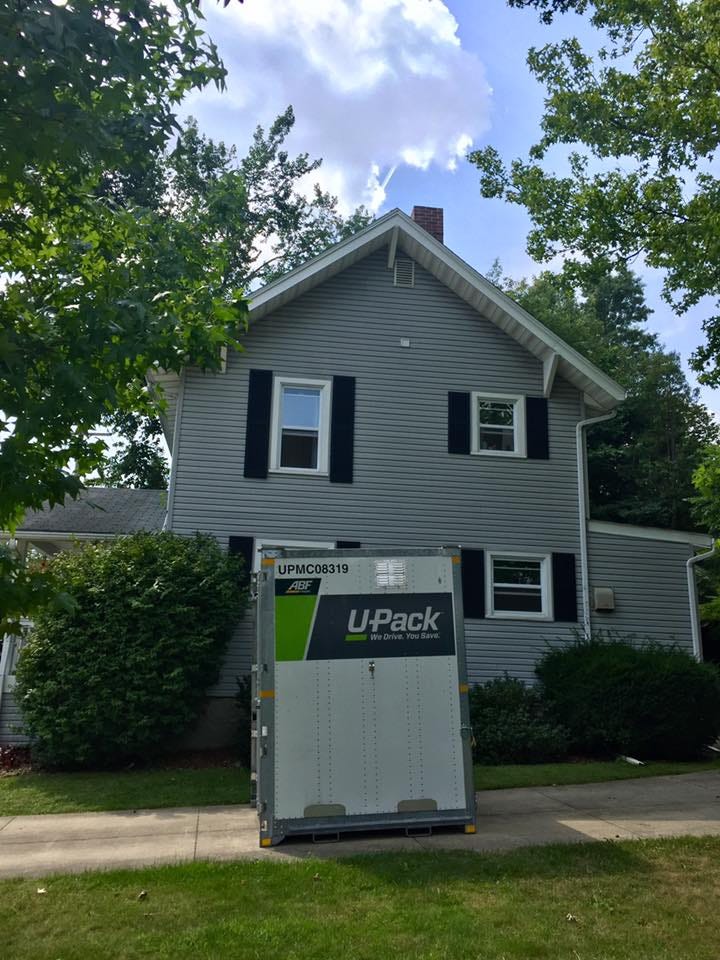
In 2017, I sold the gray house in the background and pared down my life’s possessions to that cube in the foreground, plus what I could fit in my tiny Subaru hatchback (which was not much, considering it also had to contain me, my kid, our cat, and our golden retriever).
We pulled out of that Ohio town and headed to Green Bay, Wisconsin, for my new faculty gig, as the Avett Brothers crooned, “We are headed north.”
We were headed north. I’m still north.
***
Beginning when I was in middle school, I’ve been fascinated with the way people live. I remember looking around at neighborhoods and farmhouses and apartment buildings and wondering, “Why do we all live in these boxes? And why are they all the same?” I was obsessed (OBSESSED) with the show “Extreme Homes” because it showed people who didn’t accept the default, people who quite literally thought outside the box.
My undergraduate degree is in interior design, which is probably a surprise to those of you who know me through Burned Haystack. My first design gig was at a swanky residential firm in Denver.
The firm was all women, small, and boutique-y. There was a vibe. It’s hard to describe the vibe, but I’ll tell you this: there was a system of senior designers and junior designers who worked in pairs on each job, the senior designers mentoring and bringing the junior designers along in our careers. I’m pretty sure none of the senior designers had to work for money; they were of a social strata that didn’t require it, and they pretty much all quit to become full-time socialite moms as soon as they had babies. The junior designers were young women like me—ambitious and energetic and making up in tech skills what we lacked in client experience. I think I got the job because in those days I was really good on AutoCAD, which was so new at that time that most seniors designers and architects couldn’t run it themselves.
On my first day, as I was shown around the warehouse-turned-trendy-loft space in the LoDo area of Denver—right by the Rockies stadium—I felt like I was walking through a dream. The dream was constructed of wide-plank reclaimed wood floors and exposed brick walls and Persian rugs (the real ones) and aged leather furniture. There was a holstein cow flattened into a rug beneath my desk.
After the tour, our assistant took me aside and gave me business cards for “our hair stylist, our massage therapist, our herbalist up in Boulder, and our chiropractor.”
“Oh, I don’t really need to go to a chiropractor,” I said. “I’m not hurt or anything.”
“Well,” she said, “You could probably use some kind of adjustment somewhere.” Then she said, “Oh, and here’s a set of keys to our vacation home in Jackson Hole. You can go there whenever you want.”
Having been raised middle-class in the midwest, where the holstein cows are all three-dimensional, the seemingly-mandatory herbalist and massage therapist seemed a little weird to me, but also I was 24 and there was a vacation home in Jackson Hole, and I could not believe I had landed this job. I called my mom in Ohio (from a pay phone) and told her, “You should see where I am right now.”
Over the next three months (they hired all junior designers on a three-month trial basis), I became rapidly and almost-totally disillusioned. I was interested in design challenges, in maximizing space in creative ways when there wasn’t enough of it; I was interested in the relationships between people and ergonomic factors such as lighting and ceiling heights and adjacencies to relevant spaces.
Because of the work we did here, those challenges simply didn’t exist. There was unlimited money, way more space than anyone ever needed to live in, and far too much negotiating marital tensions and disagreements over whether the throw pillows in the master suite should be knife-edge or brush-fringe, should they be Scandinavian or French Country??? I didn’t care.
Most of our clients were men who’d just purchased their third vacation home with their fourth wife, and the whole thing struck me as vapid and excessive and embarrassing.
When it came time for my three-month review, I told the HR director that I didn’t think I was a good fit for this firm, that I needed to find something that aligned more closely with my values. She looked me dead in the eye and said, “Okay, what can we do here. Do you want more money?”
I stood up and quietly walked out, walked directly into the first existential crisis of my career.
I took a job as a straight-up draftsperson, and I just sat in my cubicle all day and drew blueprints for cell phone towers for an engineering firm in Denver; our clients were Sprint and AT&T, right at the dawn of mass cell phone communication in America. I was the only woman in the entire firm, and I was only 25; I knew nothing. Other than drafting, my only duties were to go up on top of building roofs with the engineers and figure out how far the coax cable had to be run from the connection to the cell tower (the diameter of the required coaxial cable is based upon the length of the run. I know, this is so boring, lol. I’m sorry, this part is almost over).
I got pregnant and had a baby during that job, and the pregnancy was complicated and involved a dicey major surgery and a painful recovery (I had an ovarian tumor that was discovered during an early ultrasound — story for a different piece, which I am highly unlikely to write if I’m being honest). I went back to work full-time (which meant overtime in that field in that era) when I got out of the hospital, against doctor’s orders, but we needed the income. I punched my time card on Friday afternoon at the end of a long week, went directly to Starbucks for an iced tea, and my water broke right there while I was standing at the counter 😬.
Seven months after our son was born, we moved across the country back to Ohio amidst a family medical crisis, and these were difficult days. Most of that span of time exists only as a fuzzy cloud to me now, of stress and worry and exhaustion and not being able to eat.
I ended up going to work for an architecture firm in Akron, Ohio, whose client base was comprised of public libraries. It felt like destiny. It combined my love of art and design and concept development with books! And it felt socially-redeeming compared to my other design jobs. It was a small firm owned by a somewhat-unhinged Vietnam vet who was a creative genius. He trusted me and gave me almost total artistic freedom. I loved that job. The office was a renovated barn, and there were live bats hanging from the ceiling and a black cat who roamed freely from desk to desk; sometimes she sat on my lap all day while I drew.
Unlike the upscale vacation-home gig, space truly was at a premium in the public libraries, and therefore this job also offered the intellectual/artistic challenge I wanted: “lack of money and square footage but offers a social good and everyone wants it to be cool.”
Five years later, my boss’s wife became gravely ill and he sold the firm to a large corporation, which made sense, but then we all hated it and quit (including him).
For several years at this point, I’d been fantasizing about being an English teacher. I already did all the writing for the architecture firm—client communications and marketing—and I loved that part of the job. Constructing documents and arguments is not that different from constructing buildings: you need a foundation, logical connections, supports that hold up, aesthetic elements that are authentic to the task. It all felt very inter-connected to me, in intricate ways.
At the point the architecture firm disbanded, my husband and I were in a better place financially, and I could take a step back from working so much. I got a master’s in secondary education, taught high school for a year, made the leap to higher ed, got a divorce, got a Ph. D., and our son graduated from high school and went off to Ohio State while I got a tenure track job and headed up to Wisconsin (that’s called “compression” in creative nonfiction, what I just did. Did I leave out TONS? Yes. So much. It’s just not all relevant to this particular article).
What IS relevant to this particular article is that I started over in a small apartment with very few possessions. And because of that, I suddenly had a lot more time to focus on other things. It’s amazing what you can get done when you don’t have to mow the lawn, clean two stories, lie awake at night panicked over how much it’s going to cost to have your entire basement floor jackhammered up so that the plumber can rebuild the sewage pipe system that has apparently disintegrated beneath the weight of your home and the weight of being 120 years old. I wish this were a hypothetical example.
Over the next few years, I decided I didn’t want to own a house ever again, nor did I want any more space than the space I had at that time (which was 750 square feet for 750 dollars a month; excellent symmetry). My new life felt so much freer, so much more active and creative and full of possibilities. I was untethered from things, from stuff. There wasn’t much room or much to do inside, so I spent way more time outside. I took my dog hiking by the lake, and we sat by the river in the evenings and talked to my neighbors. I made friends with my colleagues and spent whole weekends camped out in coffee shops writing and chatting and laughing.
There’s another angle here too, and it’s one I don’t think we consider or talk about enough:
People, and especially women-people, tend to get trapped beneath stuff, both figuratively and literally. I’ve heard friends lament that they want to leave their toxic husbands or partners, but there’s just, like . . . all this stuff. The photo albums, the china, the school pictures on the walls and the Christmas tree ornaments. And it all just feels like too much, and so they remain trapped. The legal tangles and the financial consequences are going to be plenty hard to navigate, and then on top of that there’s all this STUFF to be divided. It feels impossible, and so they stay, partly because of their stuff. This may be an oversimplification, but I don’t think it’s an exaggeration.
And even if you take destructive relationship factors out of the equation, the stuff alone is oppressive. Our houses become repositories for children’s discarded objects, inherited heirlooms, and all the other detritus of life. In a world circumscribed by rampant materialism, sentimentality becomes weaponized in a way that encourages us to hold onto things we don’t even want, let alone need, and it suffocates us. We become unwitting curators of museums we never planned to administrate.
***
There are two ways out of being smothered by your stuff—one is by force and the other is by choice. You don’t want the former option. You don’t want your house to burn down or to be partnered with someone who is so frightening that you have to flee, though in terms of getting rid of stuff those options are both highly efficient.
You can choose it, though, and as someone who has, I recommend it strongly. It’s true there was one episode of my life in which I had to exit a domestic situation quickly—the forced downsizing model—but I was already committed to minimalism at that point, and thus is was easier on me. The part about losing stuff was easier on me, is what I’m saying. This is a lesson, too: women who’ve already made the decision to not be trapped by stuff cannot have their own possessions held for ransom against them, cannot become victims of material extortion: “So I’ll lose everything if I leave? Fine. Bye.”
I’m personally at a crossroads right now — I went from that 3-bedroom house to a one-bedroom apartment to a studio apartment (one room only, so at that point I had VERY little stuff). I’m now in a two-bedroom apartment, which feels spacious and comfortable, but honestly I’m not sure I need all this space (it’s not a lot of space by midwestern standards, just a normal two-bedroom unit, but most of the world lives in much less, and thus I’m questioning if I need this).
Anyway, this is the most rambling Substack article I’ve ever written, but the background stuff about home design feels important at least in my own mind because of how long it’s held my fascination.
The point of the article is this:
There are so many ways in which minimalism is both empowering and freeing. I hope some of you will share your stories in the comments ⬇️❤️
After leaving a 31 year marriage and raising 3 kids in a 3k sf home, I am living in a 350sf top floor studio apartment with views and could not be happier. I have everything I need (and want) and nothing I don’t. The amount of peace this tiny apartment brings me is immeasurable.
I divorced 18mo ago and the process of getting rid of 27yrs of marital stuff was daunting! I survived and it actually was therapeutic to have to hold each item and ‘Marie Kondo’ it. I said ‘thank you and good bye’ to 95% of everything and am in a tiny 2 bedroom rental and the freedom (after the initial feelings of loss of getting rid of my curated ‘life’ stuff) is palpable!